
Producers in the Rainforest: The Silent Engines Powering Our Planet
Introduction
Producers in the rainforest form the foundation of one of the most diverse ecosystems on Earth. These organisms capture energy from sunlight and convert it into chemical energy through photosynthesis, creating the food and organic matter that support countless other organisms.
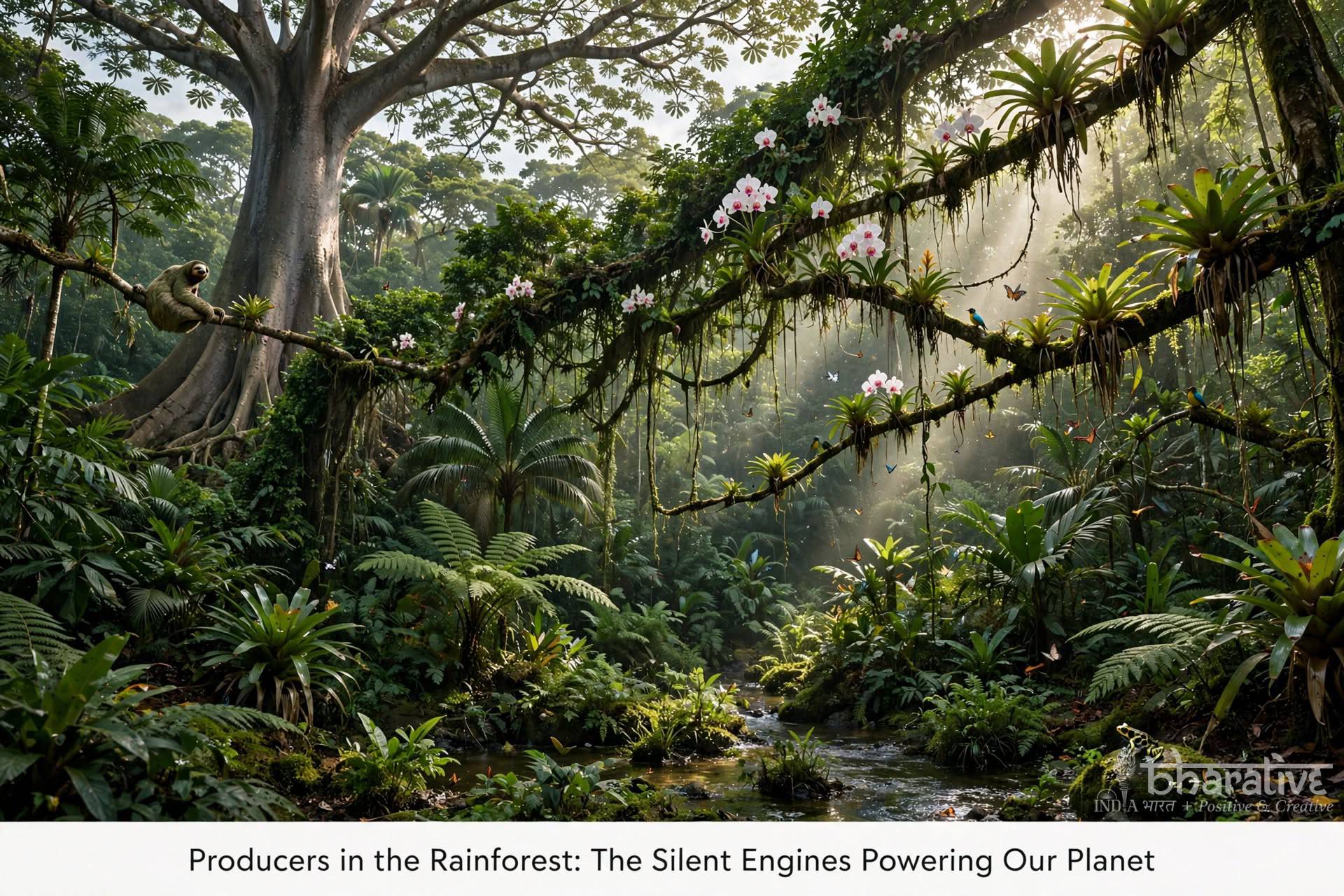
When people think about rainforests, they often picture colorful birds, monkeys, jaguars, and other wildlife. However, the plants and other photosynthetic organisms are just as important. From towering rainforest trees and climbing vines to epiphytes and aquatic plants, producers occupy different layers of the ecosystem and have developed remarkable adaptations to survive.
Understanding rainforest producers helps explain how energy moves through food webs, how different species depend on one another, and why protecting forest vegetation is essential for biodiversity and ecosystem stability.
What Is a Producer?
In ecology, organisms are commonly grouped into producers, consumers, and decomposers.
Producers, also called autotrophs, are organisms capable of making their own organic food. Green plants are the best-known examples. Through photosynthesis, they use sunlight, water, and carbon dioxide to produce sugars while releasing oxygen.
Rainforests provide warm temperatures, abundant moisture, and significant sunlight at the upper levels of the forest. At the same time, competition for sunlight is intense because the dense canopy blocks much of the available light from reaching the lower layers.
This competition has resulted in an extraordinary range of plant adaptations.
The Rainforest Layers: Where Producers Live
A rainforest is not simply a flat collection of trees. It is vertically structured into different layers, and each layer provides distinct conditions for plant life.
The Emergent Layer
The emergent layer contains some of the tallest trees in the rainforest. These trees rise above the main canopy and receive substantial amounts of direct sunlight.
Examples include:
- Kapok trees
- Brazil nut trees
- Other exceptionally tall rainforest species
Emergent trees must also withstand strong winds, intense sunlight, and greater exposure to changing weather conditions than plants growing below the canopy.
The Canopy
The canopy forms a dense roof over much of the rainforest. It receives abundant sunlight and supports a huge variety of organisms.
Important producers found around the canopy include trees, vines, and epiphytes.
Lianas are woody climbing plants that use existing trees as physical support to reach higher areas where more sunlight is available.
Epiphytes grow on other plants without necessarily taking nutrients directly from their hosts. Orchids, bromeliads, and certain ferns are examples of plants that can live high above the forest floor.
The Understory
The understory lies beneath the canopy and receives considerably less sunlight.
Plants growing here often have adaptations that allow them to use limited light efficiently. Large leaves, specialized leaf structures, and efficient light capture can help understory plants survive beneath the dense canopy.
The Forest Floor
The forest floor receives the least direct sunlight among the major rainforest layers. Even so, it supports specialized vegetation, seedlings, ferns, herbs, and other plants that are adapted to low-light conditions.
Nutrients released through decomposition also become important to plant growth, although rainforest soils can vary considerably in fertility and nutrient availability.
Producers in the Rainforest Ecosystem
Producers form the first major level of rainforest food webs.
They capture energy and convert it into organic matter that can subsequently be consumed by herbivores and other organisms.
A simplified food chain may look like:
Plants → Herbivores → Carnivores → Apex Predators
For example, leaves or fruits produced by rainforest plants can provide food for insects, sloths, monkeys, birds, and other primary consumers. Those animals may then become prey for secondary and tertiary consumers.
This makes producers essential to the flow of energy throughout the ecosystem.
The Battle for Light: Producer Adaptations
Sunlight is one of the most important limiting resources in a rainforest.
Tall trees can capture direct sunlight near the top of the forest, while plants below the canopy must survive with much less available light.
Rainforest producers have developed numerous adaptations to these conditions.
Some understory plants have broad leaves that help capture available light. Others grow rapidly when a gap opens in the canopy.
Climbing plants such as lianas use existing trees to reach brighter areas without having to develop a massive trunk of their own.
Epiphytes take advantage of elevated locations where they can access light while relying on their host plants primarily for physical support.
These adaptations allow plants to occupy different ecological niches within the same forest.
Tertiary Consumers in the Rainforest
Although producers are at the base of the food web, they are connected to organisms at every other trophic level.
Tertiary consumers and apex predators help regulate populations of other animals, including herbivores and smaller predators. By influencing animal populations, predators can indirectly affect vegetation and the wider ecosystem.
Examples of important rainforest predators include:
- Jaguars in parts of the Amazon
- Harpy eagles
- Large constrictor snakes
- Other specialized carnivores
This interconnected system demonstrates that producers do not exist independently. Their survival and regeneration are influenced by interactions throughout the entire food web.
Three Consumers in the Rainforest
Looking at individual consumers can help illustrate how energy captured by producers moves through a rainforest ecosystem.
1. Three-Toed Sloth
The three-toed sloth is a primary consumer that feeds largely on plant material, including leaves.
Because leaves can be relatively low in available energy, sloths have adaptations suited to a slow-paced lifestyle and specialized digestion.
2. Toucan
Toucans are omnivorous birds that consume a variety of foods, including fruits and animal matter such as insects and small vertebrates.
Their diet allows them to occupy a different position in the food web from specialized herbivores.
3. Green Anaconda
Green anacondas are large predators associated with aquatic and wetland environments in South America.
They feed on various animals and represent a higher trophic level in some rainforest food chains.
These examples demonstrate how energy originating with producers can move through multiple levels of a food web.
Fascinating Rainforest Producers
Rainforest plants are far more diverse than the simple category of “trees” might suggest.
The Strangler Fig
Strangler figs have a remarkable life cycle. Their seeds can germinate high in the branches of another tree after being deposited by animals.
The young plant develops roots that eventually grow toward the ground. As it matures, its roots and stems can surround the host tree.
Over time, the growing fig may become a large, independent structure. The host tree can eventually die, leaving behind a distinctive network of roots and stems.
Bromeliads
Bromeliads are flowering plants related to pineapples. Many species have leaf structures capable of collecting and holding water.
These small water reservoirs can become miniature habitats for insects and other organisms.
As organic material accumulates in the collected water, it can contribute nutrients to the plant and support a small ecosystem within the forest canopy.
Rafflesia
Rafflesia is famous for producing one of the world’s largest individual flowers. Several Rafflesia species are found in Southeast Asia.
Unlike typical green plants, Rafflesia is a parasitic plant without conventional leaves, stems, or roots. It obtains resources through its host rather than relying on photosynthesis in the usual way.
Its unusual appearance and strong odor help attract insects that assist with pollination.
Aquatic Producers in Rainforest Ecosystems
Rainforest ecosystems also include rivers, wetlands, streams, ponds, and other bodies of water that support photosynthetic organisms.
One well-known example is the giant water lily, including species in the genus Victoria.
Aquatic plants contribute to food webs and provide habitat for numerous organisms. Their presence demonstrates that rainforest producers are not limited to plants growing on land.
Open areas of water can provide access to sunlight that may be unavailable beneath dense forest vegetation.
Why Rainforest Producers Matter to Humans
Rainforest producers have ecological importance far beyond their immediate environment.
Plants contribute to carbon cycling, oxygen production, soil stability, habitat formation, and food-web support. Rainforests also contain enormous biological diversity, including species that may have useful properties for scientific research and medicine.
Historically, several important medicinal compounds have been obtained from plants or other organisms associated with tropical environments. However, the potential of rainforest biodiversity should not be exaggerated or reduced to the idea that every undiscovered plant could provide a medical breakthrough.
Protecting biodiversity preserves ecological systems and maintains opportunities for future scientific discovery.
Threats to Rainforest Producers
Rainforest vegetation faces several major environmental pressures.
Deforestation
Forest clearing for agriculture, infrastructure, logging, and other land uses can directly remove producers and destroy their habitats.
Habitat Fragmentation
Roads and other development can divide continuous forests into smaller fragments. Fragmentation can alter environmental conditions around forest edges and affect species that depend on intact habitat.
Climate Change
Changes in temperature, rainfall patterns, drought frequency, and extreme weather can place additional stress on rainforest ecosystems.
Unsustainable Resource Use
Unsustainable harvesting of timber and other natural resources can reduce forest quality and affect regeneration.
Because producers support food webs and provide habitat, their loss can have consequences throughout the ecosystem.
How Can We Help Protect Rainforest Producers?
Protecting rainforest ecosystems requires action at multiple levels, from conservation policies to responsible consumer choices.
Individuals can support rainforest protection by:
- Choosing responsibly sourced forest products where credible certification is available.
- Reducing unnecessary consumption and waste.
- Supporting reputable rainforest conservation organizations.
- Learning about sustainable agricultural and forestry practices.
- Choosing products from companies with transparent environmental sourcing policies.
- Supporting conservation initiatives that protect biodiversity and local communities.
Small individual decisions are most effective when combined with broader conservation policies, responsible business practices, and habitat protection.
Frequently Asked Questions
What are the main producers in the Amazon rainforest?
The Amazon contains an enormous diversity of producers, including large trees, palms, vines, epiphytes, shrubs, herbs, and aquatic plants. Examples include kapok trees, Brazil nut trees, rubber-producing trees, palms, orchids, and bromeliads.
How do producers in the rainforest get sunlight in the understory?
Understory plants receive limited light that passes through gaps and openings in the canopy. Many have adaptations such as broad leaves and efficient light-capturing structures that help them make use of available sunlight.
Are there aquatic producers in the rainforest?
Yes. Rainforest rivers, lakes, wetlands, and other aquatic habitats contain photosynthetic organisms and plants. Giant water lilies are one well-known example of an aquatic plant associated with South American tropical environments.
What happens if producers are removed from the food web?
Removing producers can disrupt the entire food web because primary consumers depend directly or indirectly on plant-based energy. Reduced producer availability can affect herbivores, predators, decomposers, and nutrient cycling throughout the ecosystem.
Why are rainforest producers important?
Rainforest producers capture energy, support food webs, provide habitat, contribute to carbon and nutrient cycles, and help maintain ecosystem structure and biodiversity.
Conclusion
Producers in the rainforest are the foundation of complex ecosystems that support thousands of plant and animal species.
From towering emergent trees and dense canopy vegetation to understory plants, epiphytes, vines, and aquatic producers, each occupies a different ecological role. Their ability to capture energy and create organic matter allows energy to move through the rainforest food web.
Protecting these producers means protecting much more than individual plants. It means preserving habitats, biodiversity, ecological processes, and the intricate relationships that make tropical forests among the most important ecosystems on Earth.
Understanding how rainforest producers function can help us better appreciate why forest conservation and responsible resource use matter for both nature and people.
You may also like ...