
10 Professional Hacks to Rewrite Sentences Effortlessly
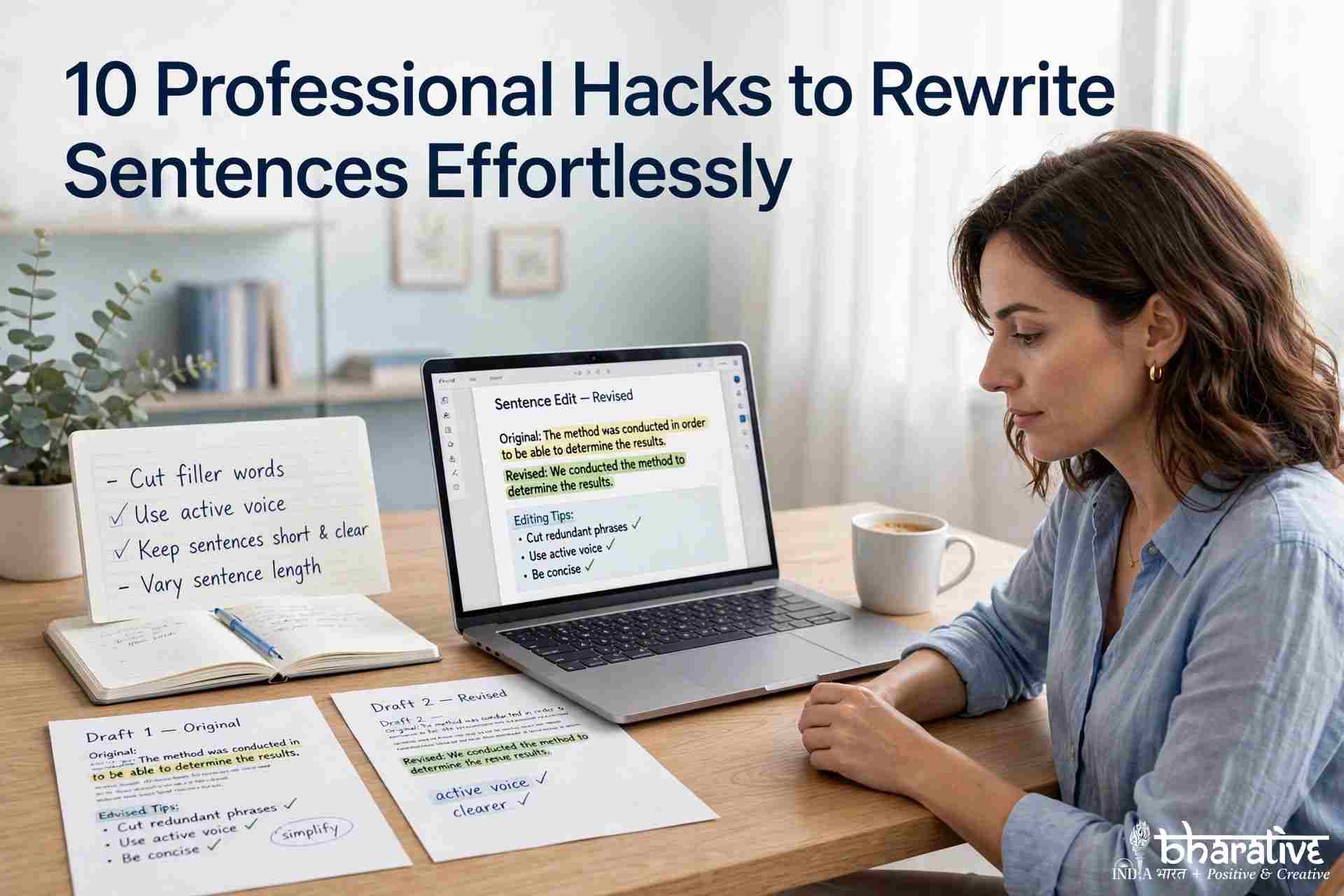
Rewriting sentences is an essential skill for students, bloggers, content creators, and professionals who want to communicate more effectively. A well-rewritten sentence improves clarity, enhances readability, reduces unnecessary repetition, and helps present ideas in a fresh and natural way. However, effective rewriting involves more than replacing individual words with synonyms. It requires understanding the original meaning, choosing appropriate language, and restructuring sentences without losing the author’s intended message.
Whether you are improving an academic assignment, polishing a blog post, editing business documents, or refining website content, learning how to rewrite sentences can make your writing more professional and engaging.
In this guide, we explore 10 professional hacks to rewrite sentences effortlessly, along with practical examples, useful writing tools, and common mistakes to avoid. By applying these techniques consistently, you can develop a smoother writing style and produce content that is clear, accurate, and easy to understand.
Easy-to-Follow Tips for Rewriting Sentences
1. Understand the Core Idea
Before rewriting any sentence, identify its main message. Understanding the original meaning helps you change the wording without introducing errors or removing important information.
Start by asking yourself what the sentence is trying to communicate. Is it explaining a fact, describing an experience, presenting an argument, or persuading the reader? Identifying its purpose helps you select the most suitable wording and tone.
Try summarizing the sentence in your own words before rewriting it. Pay attention to essential facts, relationships between ideas, and any qualifications that must remain unchanged.
Example:
Original: Regular exercise improves physical health and helps reduce stress.
Rewritten: Exercising consistently supports better physical well-being and can help manage stress.
Both sentences communicate a similar idea while using different wording and structure.
2. Use a Reliable Sentence Rewriting Tool
Online rewriting tools can help generate alternative sentence structures, suggest different expressions, and reduce the time spent on repetitive editing.
One option is Sentence Rewriter, which can be used to explore alternative ways of expressing an idea. Such tools may be particularly helpful when you are struggling to find a natural way to phrase a sentence or want to compare different versions.
To get the best results, follow these practices:
- Enter a complete sentence or a meaningful passage.
- Review the suggested alternatives rather than automatically accepting the first result.
- Check whether the rewritten version preserves the original meaning.
- Correct grammatical errors or awkward expressions.
- Adjust the tone to match your intended audience.
A rewriting tool should support your editing process, not replace your judgment. Always review the final text for accuracy, clarity, and context.
3. Experiment With AI-Assisted Writing Tools
AI-powered writing tools can provide additional ways to restructure sentences and explore different writing styles. They may suggest simpler wording, more concise expressions, or alternative sentence patterns.
Stealth Writer is an example of a tool marketed for AI-assisted rewriting and humanizing text. Depending on the available features, it may provide multiple rewritten versions that users can compare and edit.
However, no tool can guarantee that text will be undetectable by every AI detector or automatically qualify as authentic, original, or professional writing. AI detectors can produce inaccurate results, and rewriting alone does not establish originality.
For responsible use, focus on improving the quality of your writing rather than trying to bypass detection systems. Review each suggestion, verify factual claims, preserve citations where needed, and make sure the final version reflects your own understanding and intended meaning.
4. Use Synonyms Smartly
Replacing repetitive words with suitable synonyms can make your writing more varied and engaging. However, not every synonym has exactly the same meaning, tone, or level of formality.
For example, the words happy, content, delighted, and thrilled describe positive feelings, but each communicates a different degree or type of emotion.
Use these strategies to choose synonyms effectively:
- Identify repetitive words: Look for terms that appear too frequently within a paragraph.
- Check the context: Confirm that a replacement fits the meaning of the sentence.
- Maintain the right tone: Choose vocabulary that suits your audience and subject.
- Avoid unnecessary complexity: Prefer familiar words over obscure alternatives when both communicate the same idea.
Example:
Original: The new software is useful for small businesses.
Rewritten: The new software is valuable for small businesses.
The revised sentence changes one word while preserving the original message.
The goal is not to replace every word. It is to select language that makes your writing clearer and more natural.
5. Change the Sentence Structure
Changing sentence structure is one of the most effective ways to create a genuinely different version of an original sentence.
Instead of modifying individual words, consider rearranging clauses, changing the sentence opening, or combining related ideas. You can also change between active and passive voice when doing so makes sense for the context.
Example:
Original: The marketing team launched the campaign last week.
Rewritten: Last week, the campaign was launched by the marketing team.
The second sentence changes the structure and emphasis while retaining the main information.
You can also use different sentence patterns to improve flow throughout a paragraph. For example, place the most important information first when readers need to understand the main point quickly.
Remember that passive voice is not automatically better than active voice. Choose the structure that communicates your message most clearly.
6. Break Long Sentences Into Shorter Ones
Long sentences can become difficult to understand when they contain several clauses, qualifications, or unrelated ideas. Breaking them into shorter sentences can improve readability and make the main points easier to follow.
Start by identifying the different ideas within a sentence. If each idea can stand independently, consider separating them while preserving the logical connection between them.
Example:
Original: The company introduced a new training program to improve employee performance, strengthen communication, and help team members adapt to updated workplace procedures.
Rewritten: The company introduced a new training program to improve employee performance. The program also aims to strengthen communication and help team members adapt to updated workplace procedures.
The revised version separates the information into two manageable sentences.
However, do not shorten every sentence automatically. A mix of short and longer sentences creates a more natural rhythm and prevents writing from sounding repetitive.
7. Combine Simple Sentences for Better Flow
Although long sentences can be difficult to read, too many short sentences can make writing feel disconnected. Combining related sentences helps establish relationships between ideas and creates smoother transitions.
Look for sentences that share the same subject, describe connected actions, or explain related facts. You can join them using conjunctions, relative clauses, or appropriate punctuation.
Example:
Original: She loves painting. She spends hours in her studio.
Rewritten: She loves painting and spends hours working in her studio.
The revised sentence expresses both ideas more smoothly.
Another example:
Original: The website loads quickly. It provides a simple user experience.
Rewritten: The website loads quickly and offers a simple user experience.
The best combinations maintain clarity without creating unnecessarily long sentences. Use this technique when the ideas naturally belong together.
8. Cut Unnecessary Words and Filler
Concise writing communicates ideas directly without sacrificing important details. Unnecessary words, repeated expressions, and excessive modifiers can weaken a sentence and make readers work harder to understand it.
To make your writing more precise, look for:
- Excessive modifiers: Words such as very, really, and quite may be unnecessary when a stronger, more precise word is available.
- Repeated ideas: Avoid expressing the same point multiple times without adding useful information.
- Wordy phrases: Replace long expressions with shorter alternatives when the meaning remains the same.
- Unnecessary introductions: Remove phrases that delay the main point without serving a clear purpose.
Example:
Original: Due to the fact that the meeting was delayed, we arrived late.
Rewritten: Because the meeting was delayed, we arrived late.
The revised sentence is shorter and easier to understand.
Conciseness does not mean removing every descriptive word. Keep details that add meaning, improve precision, or help readers understand the context.
9. Add Sensory Language When Appropriate
Sensory language uses details associated with sight, sound, touch, taste, and smell to create a more vivid description. It is especially useful in storytelling, lifestyle articles, travel writing, product descriptions, and creative content.
Instead of relying on vague descriptions, choose details that help readers imagine the experience.
Example:
Original: The cake was good.
Rewritten: The cake smelled of rich chocolate and tasted pleasantly sweet.
The second sentence provides a clearer impression by describing the cake’s aroma and taste.
Sensory language should match the purpose of your writing. It can enrich a descriptive article, but it may be unnecessary in a technical report, legal document, or concise business email.
The key is to add meaningful detail rather than decorative language that distracts from the main message.
10. Read Your Rewritten Sentences Aloud
Reading your writing aloud is a simple but effective way to identify problems that may be difficult to notice when reading silently.
As you read, listen for awkward phrasing, repeated words, unclear transitions, and sentences that are difficult to follow in one breath. These signs can indicate that a sentence needs further editing.
Follow this process:
- Read the rewritten sentence at a natural pace.
- Identify any words or phrases that sound awkward.
- Check whether the main idea is immediately understandable.
- Adjust the sentence structure or vocabulary.
- Read it again to confirm that the revision flows naturally.
This technique is particularly useful for presentations, speeches, video scripts, and conversational content.
A sentence that sounds natural when spoken is often easier for readers to understand, although written and spoken communication may require different styles.
Practice Regularly to Improve Your Rewriting Skills
Rewriting becomes easier when you practise consistently. Instead of relying entirely on automated tools, spend a few minutes each day improving sentences from your own writing or from material you are permitted to use for practice.
Try rewriting a short paragraph in three different ways:
- Create a simpler version for a general audience.
- Produce a more concise version without losing essential details.
- Rewrite it in a professional tone suitable for a business document.
Compare the versions to understand how vocabulary, structure, and tone affect readability.
Students working on essays, research projects, and other academic assignments can also consult resources such as DoMyProject.org for additional support with writing structure and project organization. Make sure to follow your institution’s academic integrity policies and accurately acknowledge sources when required.
Over time, regular practice helps you recognize unnecessary wording, improve sentence flow, and make better decisions about vocabulary and structure.
How AI Tools Can Make Writing More Efficient
Modern content creation frequently involves text, images, illustrations, and other digital assets. AI-powered tools can help streamline certain tasks, allowing creators to spend more time on planning, editing, and improving their work.
For example, AIVector offers a tool for converting PNG images into SVG format. This can be useful for designers and content creators who need scalable graphics for websites or other digital projects.
While image conversion is different from sentence rewriting, both types of tools can support a more efficient content workflow by reducing repetitive manual work.
When choosing an AI tool, consider its actual capabilities, output quality, ease of use, privacy practices, and any usage limitations. Avoid assuming that an automated result is always accurate or ready to publish.
The most effective workflow combines automation with human review. Tools can provide suggestions and speed up routine tasks, while writers remain responsible for meaning, accuracy, originality, and the final quality of the content.
Four Common Pitfalls to Avoid When Rewriting Sentences
Even when you use effective techniques, certain mistakes can undermine your results. Avoid these four common problems.
1. Changing Words Without Improving the Sentence
Replacing a few words with synonyms may leave the original sentence structure unchanged. It can also introduce awkward expressions if the replacement words do not fit the context.
Instead, consider the sentence’s purpose, organization, tone, and clarity before deciding what to change.
2. Over-Editing the Original Message
Excessive rewriting can make a sentence complicated or unnatural. A revision does not need to look completely different if the original already communicates its meaning effectively.
Make changes that serve a purpose, and stop when the sentence is clear and appropriate.
3. Losing Important Meaning or Context
A rewritten sentence should preserve essential facts, qualifications, relationships, and intended meaning. Removing a limitation or changing a key term can unintentionally alter the message.
Compare the revised version with the original to make sure no important information has been lost.
4. Using Stiff or Artificial Language
Overly formal phrases and unusual synonyms can make writing feel mechanical. Professional writing should be appropriate for its audience without becoming unnecessarily complicated.
Choose natural expressions, use clear sentence structures, and read the final version aloud to check its flow.
Frequently Asked Questions About Sentence Rewriting
What is sentence rewriting?
Sentence rewriting is the process of expressing an existing idea in different words or sentence structures while preserving its intended meaning. It can improve clarity, tone, readability, and conciseness.
How can I rewrite sentences without changing their meaning?
First, identify the original sentence’s central idea and essential details. Then change the vocabulary or structure while retaining the same facts and relationships. Finally, compare both versions to check for unintended changes.
Can AI tools help me rewrite sentences?
Yes. AI-assisted writing tools can suggest alternative wording, simplify complicated sentences, and offer different structures. However, their suggestions should always be reviewed for accuracy, context, tone, and meaning.
Is replacing words with synonyms enough?
Not always. Effective rewriting may involve changing sentence structure, reorganizing clauses, removing unnecessary words, or adjusting the level of detail. Simply substituting synonyms can produce awkward or inaccurate results.
How can I make rewritten sentences sound more natural?
Use familiar vocabulary, vary sentence length, avoid unnecessary modifiers, and read your work aloud. Revising sentences in the context of the surrounding paragraph also helps maintain a consistent tone.
Does rewriting automatically prevent plagiarism?
No. Rewriting alone does not eliminate plagiarism. When you use another person’s ideas, research, or distinctive arguments, you may still need to provide appropriate citations, even if you express those ideas in your own words. Follow the relevant academic or professional guidelines.
Conclusion
Rewriting sentences effectively requires a combination of clear thinking, appropriate vocabulary, structural variety, and careful editing. By understanding the core idea, using synonyms thoughtfully, restructuring sentences, removing unnecessary words, and checking the final result aloud, you can improve your writing without losing its original meaning.
Online rewriting tools and AI-assisted writing applications can make the process faster by providing alternative expressions and useful suggestions. However, the strongest results come from combining these tools with human judgment, contextual understanding, and consistent practice.
Whether you are a student, blogger, professional, or content creator, these 10 professional hacks can help you develop clearer, more natural, and more polished writing. Focus on communicating your ideas accurately rather than changing words simply for the sake of making a sentence look different.
Disclaimer
This article is intended for general informational purposes. Third-party tools and services mentioned here are provided as examples, and their features, availability, pricing, and terms may change. Review each provider’s current policies before using its services. When rewriting academic, professional, or published material, preserve the original meaning, verify factual claims, respect copyright, and follow applicable citation and content-use requirements.
You may also like ...