50 Metaphors for Fear With Meanings and Examples
Fear can feel like a dark shadow creeping in when we least expect it. It is a powerful emotion that can make us hesitate, avoid challenges, or worry about what might happen next. Metaphors give us a creative way to describe these feelings by comparing fear to familiar objects, places, situations, and experiences.
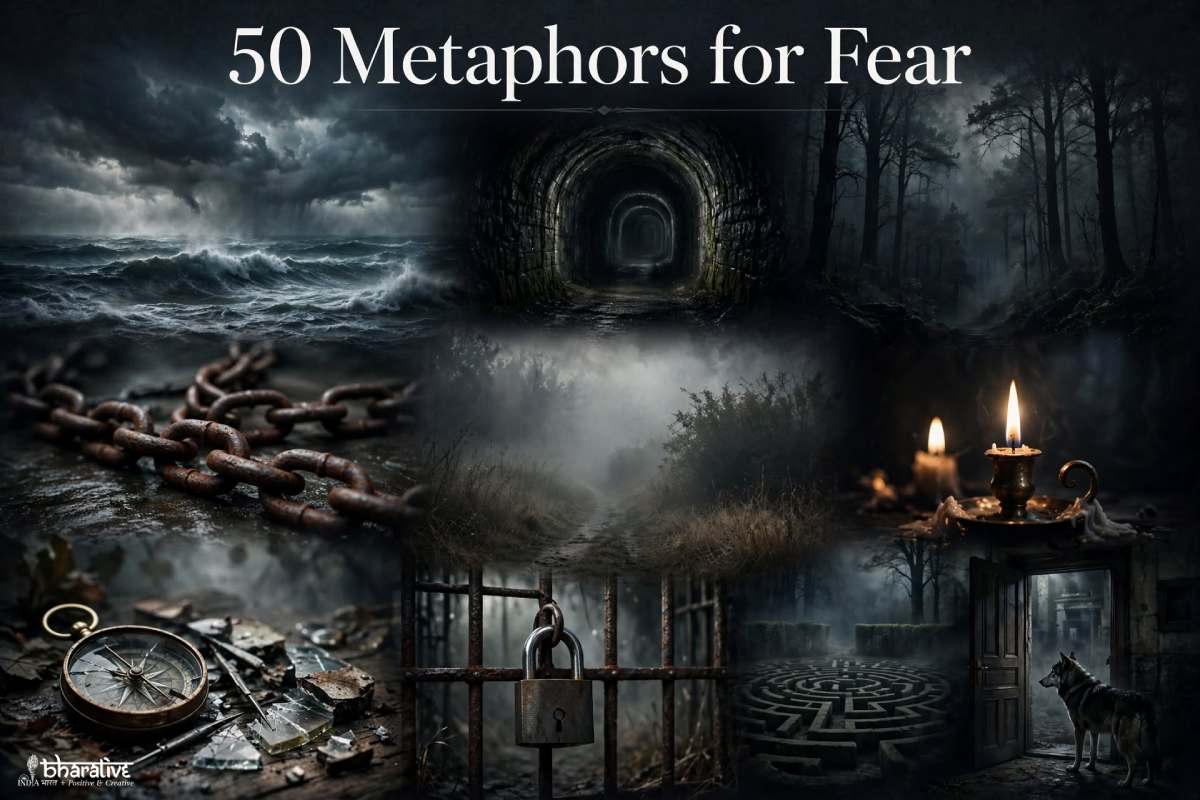
For example, fear can be a dark tunnel, a stormy sea, a heavy weight, or even a wolf at the door. These comparisons help make an invisible emotion easier to understand and express.
Whether you are writing a story, improving your vocabulary, or trying to describe an emotional experience, these metaphors for fear can help you communicate your ideas more vividly.
Metaphors for Fear
1. Fear is a dark tunnel.
Meaning: Fear can feel like being trapped in a dark and frightening place without knowing where the way out is.
In a Sentence: Whenever I have to speak in front of the class, it feels like I’m stuck in a dark tunnel of fear.
Other Ways to Say: Fear is like being lost in a maze; Fear is like being in a pitch-black room.
2. Fear is a heavy weight on your shoulders.
Meaning: Fear can feel like carrying a heavy burden that makes it difficult to move forward.
In a Sentence: The thought of taking a test feels like a heavy weight on my shoulders.
Other Ways to Say: Fear is like carrying a load of bricks; Fear is like wearing a lead jacket.
3. Fear is a thunderstorm.
Meaning: Fear can resemble a storm filled with sudden changes, loud emotions, and uncertainty.
In a Sentence: Walking alone in the dark feels like being caught in a thunderstorm of fear.
Other Ways to Say: Fear is like a hurricane; Fear is like a tornado ripping through your mind.
4. Fear is a deep ocean.
Meaning: Fear can feel like being surrounded by a vast and unknown space that is difficult to navigate.
In a Sentence: Starting a new school feels like diving into the deep ocean of fear.
Other Ways to Say: Fear is like swimming in the abyss; Fear is like treading water in the deep sea.
5. Fear is a shadow lurking in the corner.
Meaning: Fear can feel like a dark presence that follows you and creates uneasiness.
In a Sentence: Walking home alone at night, I feel like there’s a shadow of fear lurking in every corner.
Other Ways to Say: Fear is like a ghost haunting your thoughts; Fear is like a dark figure lurking in the shadows.
6. Fear is a maze with no exit.
Meaning: Fear can make you feel trapped in a confusing situation without seeing a solution.
In a Sentence: Trying to make a decision when you’re scared is like being stuck in a maze with no exit.
Other Ways to Say: Fear is like being lost in a labyrinth; Fear is like navigating through a complex maze.
7. Fear is a boulder blocking your path.
Meaning: Fear can become an obstacle that prevents you from making progress.
In a Sentence: The fear of failure is like a huge boulder blocking my path to success.
Other Ways to Say: Fear is like a roadblock on your journey; Fear is like a barrier preventing you from moving forward.
8. Fear is a dark cloud hanging overhead.
Meaning: Fear can feel like a constant threat that casts a shadow over your thoughts.
In a Sentence: The fear of the unknown feels like a dark cloud hanging over my future.
Other Ways to Say: Fear is like a storm cloud brewing; Fear is like a shadow looming over your dreams.
9. Fear is a maze of tangled wires.
Meaning: Fear can create confusion and make your thoughts feel difficult to untangle.
In a Sentence: Trying to make sense of my fears is like untangling a maze of tangled wires.
Other Ways to Say: Fear is like a knot that can’t be unraveled; Fear is like a puzzle with missing pieces.
10. Fear is a wildfire spreading quickly.
Meaning: Fear can grow rapidly and consume your thoughts if it is allowed to spread.
In a Sentence: The fear of rejection can spread through your mind like wildfire, making you doubt yourself.
Other Ways to Say: Fear is like a forest fire out of control; Fear is like a blaze that engulfs your thoughts.
11. Fear is a trap waiting to spring.
Meaning: Fear can feel like a hidden danger that may suddenly catch you off guard.
In a Sentence: Walking alone at night feels like stepping into a trap of fear waiting to spring.
Other Ways to Say: Fear is like a snare lying in wait; Fear is like a net ready to ensnare you.
12. Fear is a dark forest with no path.
Meaning: Fear can make you feel lost in an unfamiliar situation without knowing which direction to take.
In a Sentence: Facing my fears is like wandering through a dark forest with no path to follow.
Other Ways to Say: Fear is like a thicket blocking your way; Fear is like a wilderness with no trail.
13. Fear is a stormy sea.
Meaning: Fear can feel like being tossed around by powerful emotions that are difficult to control.
In a Sentence: Confronting my fears is like sailing through a stormy sea, with waves crashing all around.
Other Ways to Say: Fear is like a tempest raging within you; Fear is like a turbulent ocean.
14. Fear is a spider spinning its web.
Meaning: Fear can slowly surround you with worries until you feel trapped.
In a Sentence: The fear of failure weaves a web of doubt around my thoughts, trapping me in its snare.
Other Ways to Say: Fear is like a spider ensnaring its prey; Fear is like a web that entangles your mind.
15. Fear is a dark room without a light.
Meaning: Fear can feel like being surrounded by darkness without knowing how to find your way forward.
In a Sentence: When I’m afraid, it’s like being trapped in a dark room with no light to guide me.
Other Ways to Say: Fear is like a black hole sucking you in; Fear is like a shadow blocking out the sun.
16. Fear is a sharp knife at your throat.
Meaning: Fear can create an intense sense of danger and vulnerability.
In a Sentence: Speaking up in class feels like having a sharp knife of fear pressed against my throat.
Other Ways to Say: Fear is like a dagger piercing your heart; Fear is like a blade cutting through your confidence.
17. Fear is a mountain too high to climb.
Meaning: Fear can make a challenge appear impossible to overcome.
In a Sentence: The fear of failure can make success feel like trying to climb a mountain that’s too high.
Other Ways to Say: Fear is like a peak beyond your reach; Fear is like an obstacle blocking your ascent.
18. Fear is a ghost haunting your thoughts.
Meaning: Fear can remain in your mind even when the immediate danger is gone.
In a Sentence: The fear of the dark feels like a ghost haunting my thoughts, making me scared to sleep.
Other Ways to Say: Fear is like a specter lurking in the shadows; Fear is like a phantom haunting your dreams.
19. Fear is a snake coiled in the grass.
Meaning: Fear can represent a hidden danger that seems ready to strike unexpectedly.
In a Sentence: Walking alone in the dark feels like stepping into a field with a snake of fear coiled in the grass.
Other Ways to Say: Fear is like a serpent lying in wait; Fear is like a viper ready to strike.
20. Fear is a puzzle with missing pieces.
Meaning: Fear can make it difficult to understand a situation because you do not have all the information you need.
In a Sentence: Trying to understand my fears is like solving a puzzle with missing pieces.
Other Ways to Say: Fear is like an incomplete puzzle; Fear is like a mystery with important clues missing.
21. Fear is a rollercoaster ride.
Meaning: Fear can bring sudden emotional ups and downs that feel difficult to control.
In a Sentence: Facing my fears is like riding a rollercoaster, with moments of exhilaration and moments of terror.
Other Ways to Say: Fear is like a thrill ride; Fear is like a wild roller coaster of emotions.
22. Fear is a dark cave.
Meaning: Fear can feel like entering a place filled with darkness and uncertainty.
In a Sentence: Confronting my fears is like exploring a dark cave, unsure of what dangers lie ahead.
Other Ways to Say: Fear is like a cavern of unknown depths; Fear is like a hidden grotto of anxiety.
23. Fear is a swarm of bees.
Meaning: Fear can feel like many anxious thoughts buzzing around your mind at once.
In a Sentence: When I’m anxious, it feels like a swarm of bees buzzing around in my head.
Other Ways to Say: Fear is like a hive of buzzing bees; Fear is like a cloud of angry wasps.
24. Fear is a haunted house.
Meaning: Fear can surround you with unsettling thoughts and unexpected emotional reactions.
In a Sentence: Confronting my fears is like walking through a haunted house, with unexpected scares around every corner.
Other Ways to Say: Fear is like a spooky mansion; Fear is like a chilling ghost story.
25. Fear is a ticking time bomb.
Meaning: Fear can feel like a threat that might suddenly turn into intense panic or anxiety.
In a Sentence: Living with constant anxiety can feel like carrying around a ticking time bomb of fear.
Other Ways to Say: Fear is like a countdown to disaster; Fear is like a bomb waiting to detonate.
26. Fear is a tightrope walk.
Meaning: Fear can feel like trying to maintain balance while facing a risky or uncertain situation.
In a Sentence: Facing my fears is like walking a tightrope, with the constant fear of falling.
Other Ways to Say: Fear is like a high-wire act; Fear is like balancing on a razor’s edge.
27. Fear is a wolf at the door.
Meaning: Fear can feel like a threatening presence waiting just outside your sense of safety.
In a Sentence: The fear of failure feels like a hungry wolf scratching at the door of my confidence.
Other Ways to Say: Fear is like a prowling predator; Fear is like a menacing beast lurking nearby.
28. Fear is a dark forest with unseen eyes.
Meaning: Fear can feel like being surrounded by hidden dangers that you cannot see.
In a Sentence: Walking alone at night feels like wandering through a dark forest with unseen eyes watching my every move.
Other Ways to Say: Fear is like a shadowy forest with hidden threats; Fear is like a wilderness with lurking predators.
29. Fear is a stormy sky.
Meaning: Fear can represent an approaching threat that creates tension and uncertainty.
In a Sentence: The fear of the unknown hangs over me like a stormy sky, darkening my thoughts.
Other Ways to Say: Fear is like a thundercloud looming overhead; Fear is like a tempest brewing on the horizon.
30. Fear is a maze of twisted paths.
Meaning: Fear can make your thoughts feel confusing and leave you unsure which direction to take.
In a Sentence: Trying to understand my fears is like navigating through a maze of twisted paths, never knowing which way to turn.
Other Ways to Say: Fear is like a convoluted puzzle; Fear is like a tangled web of confusion.
31. Fear is a frozen lake.
Meaning: Fear can make you feel frozen in place and unable to act.
In a Sentence: When faced with a difficult decision, fear can freeze me in a place like a lake in winter.
Other Ways to Say: Fear is like ice locking you in place; Fear is like being trapped in permafrost.
32. Fear is a dark forest with tangled branches.
Meaning: Fear can feel like being surrounded by obstacles that make progress difficult.
In a Sentence: Trying to overcome my fears is like navigating through a dark forest with tangled branches blocking my path.
Other Ways to Say: Fear is like a thicket of barriers; Fear is like a dense jungle of uncertainty.
33. Fear is a snake shedding its skin.
Meaning: Fear can represent the process of leaving old fears or limiting beliefs behind and moving toward change.
In a Sentence: Confronting my fears feels like shedding the skin of my old self and embracing new possibilities.
Other Ways to Say: Fear is like molting old fears; Fear is like shedding layers of doubt.
34. Fear is a maze with dead ends.
Meaning: Fear can make you feel trapped in a situation where every choice seems to lead nowhere.
In a Sentence: Trying to escape my fears is like navigating through a maze with dead ends at every turn.
Other Ways to Say: Fear is like hitting a brick wall; Fear is like running into a dead-end street.
35. Fear is a stormy sea with no shore in sight.
Meaning: Fear can feel like being lost in uncertainty without knowing when the difficult experience will end.
In a Sentence: Facing my fears feels like sailing through a stormy sea with no shore in sight, unsure of when the tempest will end.
Other Ways to Say: Fear is like being lost at sea; Fear is like drifting on an endless ocean.
36. Fear is a trapdoor beneath your feet.
Meaning: Fear can feel like the sudden possibility of losing control or being plunged into panic.
In a Sentence: The fear of failure can feel like standing on a trapdoor, never knowing when it will open beneath me.
Other Ways to Say: Fear is like a bottomless pit; Fear is like a sudden drop into darkness.
37. Fear is a riddle without an answer.
Meaning: Fear can make a situation seem impossible to understand or solve.
In a Sentence: Understanding my fears is like trying to solve a riddle without an answer, leaving me puzzled and confused.
Other Ways to Say: Fear is like an unsolvable puzzle; Fear is like a mystery without clues.
38. Fear is a shadow in the night.
Meaning: Fear can feel like a dark presence that follows you and creates uncertainty.
In a Sentence: The fear of the unknown lurks in the shadows of my mind like a shadow in the night.
Other Ways to Say: Fear is like a specter haunting your thoughts; Fear is like a phantom in the darkness.
39. Fear is a storm cloud blocking the sun.
Meaning: Fear can overshadow positive thoughts and make hope seem distant.
In a Sentence: The fear of failure hangs over me like a storm cloud, blocking out the sunlight of hope and optimism.
Other Ways to Say: Fear is like a thundercloud on the horizon; Fear is like a dark fog enveloping your thoughts.
40. Fear is a spider weaving its web.
Meaning: Fear can gradually surround you with worries and make you feel trapped.
In a Sentence: The fear of the future weaves a tangled web of uncertainty around my thoughts, trapping me in its sticky strands.
Other Ways to Say: Fear is like a spider spinning its web of doubt; Fear is like being caught in a web of fears.
41. Fear is a closed door.
Meaning: Fear can feel like an obstacle that prevents you from moving forward or exploring new possibilities.
In a Sentence: The fear of rejection can feel like coming up against a closed door, blocking my path to success.
Other Ways to Say: Fear is like hitting a dead end; Fear is like encountering a barrier.
42. Fear is a foggy path.
Meaning: Fear can make the future seem unclear and difficult to navigate.
In a Sentence: Trying to overcome my fears feels like walking along a foggy path, unsure of what lies ahead.
Other Ways to Say: Fear is like stumbling through the mist; Fear is like traversing a cloudy road.
43. Fear is a stormy horizon.
Meaning: Fear can feel like seeing trouble approaching while not knowing exactly what will happen.
In a Sentence: The fear of the unknown appears like a stormy horizon, making me worry about what comes next.
Other Ways to Say: Fear is like dark clouds gathering; Fear is like a tempest approaching in the distance.
44. Fear is a maze of mirrors.
Meaning: Fear can trap you in confusing thoughts and reflections of your own doubts.
In a Sentence: Confronting my fears feels like navigating through a maze of mirrors, where every reflection reveals a different aspect of my anxieties.
Other Ways to Say: Fear is like getting lost in a hall of mirrors; Fear is like facing a distorted image of yourself.
45. Fear is a broken compass.
Meaning: Fear can make you lose your sense of direction and feel uncertain about what to do next.
In a Sentence: When I’m overcome with fear, it’s like my internal compass is broken, and I don’t know which way to turn.
Other Ways to Say: Fear is like a malfunctioning GPS; Fear is like a compass needle spinning out of control.
46. Fear is a locked cage.
Meaning: Fear can make you feel confined and unable to take action or pursue opportunities.
In a Sentence: My fear of failure feels like a locked cage keeping me from trying something new.
Other Ways to Say: Fear is like a prison without bars; Fear is like being trapped behind invisible walls.
47. Fear is an alarm bell ringing in the dark.
Meaning: Fear can act like an internal warning that something may be wrong or dangerous.
In a Sentence: Every unfamiliar sound at night feels like an alarm bell ringing in the dark.
Other Ways to Say: Fear is like a warning siren; Fear is like an emergency signal inside your mind.
48. Fear is a wall of ice.
Meaning: Fear can create an emotional barrier that makes it difficult to act, speak, or connect with others.
In a Sentence: Her fear of rejection became a wall of ice between her and the people around her.
Other Ways to Say: Fear is like a frozen barrier; Fear is like an icy wall blocking connection.
49. Fear is a chain around your feet.
Meaning: Fear can hold you back and make progress feel difficult.
In a Sentence: My fear of making mistakes feels like a chain around my feet, stopping me from moving forward.
Other Ways to Say: Fear is like an anchor dragging you down; Fear is like chains holding you back.
50. Fear is a candle flickering before the wind.
Meaning: Fear can represent uncertainty and vulnerability, especially when confidence feels fragile.
In a Sentence: Before giving my speech, my confidence felt like a candle flickering before the wind.
Other Ways to Say: Fear is like a fragile flame; Fear is like a small light struggling against the darkness.
Also Read: 35 Similes for Calm: Meanings and Examples
How to Use Metaphors for Fear
Metaphors for fear can make your writing more vivid and emotionally powerful. Instead of simply saying that someone is afraid, you can show what that fear feels like.
For example:
- Simple: She was afraid of the interview.
- With a metaphor: The interview was a dark tunnel she was afraid to enter.
- Simple: He was afraid of failure.
- With a metaphor: Fear was a heavy chain around his feet.
- Simple: I was nervous about the unknown.
- With a metaphor: The future was a foggy path disappearing into the distance.
These comparisons help readers imagine the emotion rather than simply being told about it.
Tips for Writing Metaphors About Fear
- Use familiar images: Objects such as shadows, storms, doors, cages, and chains are easy for readers to visualize.
- Match the intensity: A small worry might be described as a flickering flame, while overwhelming fear could be represented by a raging storm.
- Show the emotional effect: Think about whether fear makes a person feel trapped, confused, frozen, threatened, or uncertain.
- Avoid unnecessary repetition: Choose different images to describe different aspects of fear.
- Use metaphors naturally: A strong metaphor should support the meaning of the sentence rather than distract from it.
- Consider your audience: Simple metaphors are often more effective for students and beginner writers.
Exercise to Practice
Fill in the blanks with suitable words to complete each metaphor.
- Overcoming fear is like ________ through a dark tunnel.
- Facing fear feels like carrying a heavy ________ on your shoulders.
- Confronting fear is like sailing through a ________ sea.
- Challenging fear is like navigating through a dense ________.
- Defeating fear is like unraveling a tangled ________.
- Tackling fear is like opening a ________ door.
- Conquering fear feels like dispelling a storm ________.
- Mastering fear is like breaking free from a sticky ________.
- Triumphing over fear is like emerging from a dark ________.
- Overpowering fear feels like unlocking a sealed ________.
- Subduing fear is like dispelling a thick ________.
- Succeeding despite fear is like escaping a sinking ________.
- Achieving despite fear is like finding a path through a dense ________.
- Excelling despite fear is like casting away a shadowy ________.
Suggested Answers
- Walking
- Weight
- Stormy
- Forest
- Knot
- Locked
- Cloud
- Web
- Cave
- Door
- Fog
- Ship
- Forest
- Figure
Conclusion
Metaphors offer a creative way to understand and express fear. By comparing fear to familiar experiences such as dark tunnels, stormy seas, heavy weights, locked cages, and broken compasses, we can describe complex emotions in ways that are easier to visualize.
Fear can feel overwhelming, confusing, threatening, or restrictive, but putting those feelings into words can make them easier to understand. Whether you are writing a story, poem, essay, or personal reflection, these metaphors can help you communicate fear with greater clarity and imagination.
The next time you need to describe fear, choose an image that matches the feeling you want to express. A powerful metaphor can turn a simple sentence into a vivid picture that readers can immediately understand.
You may also like ...